
Contact information


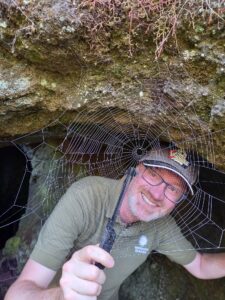
Searching for spider webs in the rainforest of Panama

Dr. Thomas Hesselberg
Marie Curie Postdoctoral Fellow
University of Oxford
Department of Zoology
South Parks Road, Oxford, OX1 3PS
United Kingdom

Email: thomashesselberg@gmail.com
Research interests: Animal Behaviour, Arachnology, Behavioural Ecology, Biomimetics, Comparative Biomechanics, Comparative Physiology, Invertebrate Zoology, Neuro-ethology, Sensory Biology


.


Research


My reseach focuses on how behaviour in invertebrates, primarily orb spiders and their webs, is shaped by internal physiological and external environmental factors. In particular, I am interested in how behaviour in general and behavioural plasticity in particular has evolved to cope with the constraints imposed by a relatively limited brain capacity and biomechanical constraints imposed by morphological and external physical factors as well as silk material properties. The goal is to increase our basic understanding of how small-brained creatures use simple decision-making rules to perform complex behaviours. In addition to its intrinsic biological interest, this line of research is of potential interest to designers of biologically inspired robots and other biomimetic technologies.


Current Research Projects


My current project is done in the Oxford Silk Group under supervision of Prof. Fritz Vollrath and aims to investigate how orb spiders with different energetic web-building costs adjust their building behaviour and the resultant web geometry to both changes in and predictability of environmental conditions. Specifically, I focus on two functional (biotic and abiotic) aspects of the web; its ability to capture prey and to withstand wind. In collaboration with Professor Tobias Wang from the University of Aarhus, I rank energetic costs from four orb spider species, by measuring both material and web-building costs in a metabolic chamber.

To analyse the effects of wind, orb webs are studied in a wind tunnel with the specific aim to study, whether spiders change their investment strategy in unsteady and unpredictable winds.
To analyse the effects of prey impact, high speed cameras will be used with the objective to quantify how spiders with different energetic investment strategies adapt their webs to different prey. Prof. Adrian Thomas from the Oxford Flight Group provides guidance and advice for the kinematic and aerodynamic analyses of prey movements and web deformations. Finally, analytical models (using finite element analysis) is used to uncover the underlying dynamics of webs during both prey impact and wind loading, with the goal to relate web-geometry with web-engineering, i.e. force distribution and energy dissipation.

This provides information on the functional importance of the various substructures in the webs in order to examine and predict the optimisation criteria for web design in specific environments. The results are expected to increase our understanding of the different spiders' web-building behaviour and how their resultant orb webs adapt to changes in wind conditions and prey size. This will ideally be of interest to both engineers working with light weight structures, and to biologist interested in animals' decision making strategies in a changing environment.

Syndicate content